
PlaylistPal vs SubmitHub, Groover & Playlist Push: The Honest 2026 Comparison
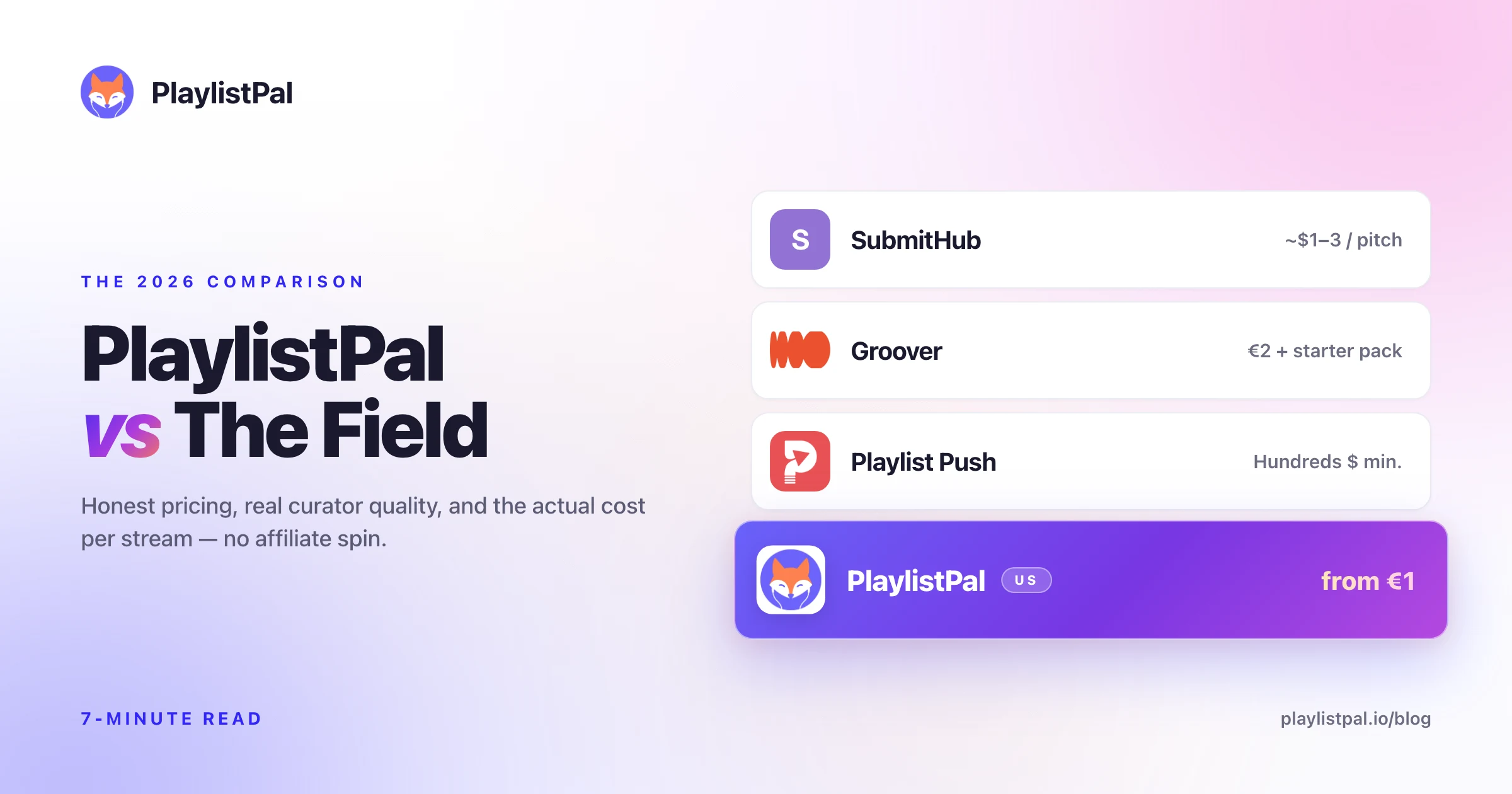
If you're an independent artist trying to figure out where to actually spend your Spotify promotion budget in 2026, you've probably opened 12 browser tabs comparing SubmitHub, Groover, Playlist Push, SoundCampaign, Daimoon Media, Boost Collective, and PlaylistPal — and every "review" site you land on is owned by one of the platforms it's reviewing.
This isn't that.
We're going to name names, link to every competitor, quote real pricing, and tell you exactly where each one wins and where each one loses. Yes, we make PlaylistPal — and we'll tell you upfront where we're newer or smaller. But by the time you finish reading, you'll know exactly which platform fits your release, your budget, and your genre.
TL;DR — If you want the cheapest per-playlist pitches with full transparency on who you're pitching, PlaylistPal wins on price and curator quality (€1–€3 per playlist with verified, tiered curators). If you want the largest established curator pool, SubmitHub still has it. If you have a few hundred dollars and want a managed campaign, Playlist Push is legitimate but expensive. Avoid anyone promising "guaranteed streams" — that's how you get hit with Spotify's anti-payola rules.
A note on the numbers below: Competitor pricing and policies change. We've cross-checked everything against each platform's live site as of mid-2026, but for the most current rates, always click through to the competitor's pricing page (we link to every one) before you decide.
The 2026 Spotify Playlist Pitching Landscape — At a Glance
| Platform | Pricing model | Entry point | Per-pitch / per-playlist cost | Curator pool | Best for |
|---|---|---|---|---|---|
| PlaylistPal | Credits, per-playlist | €1 (1 playlist, Bronze) | €1–€3 per playlist | Vetted curators + IG/TikTok influencers, millions of combined followers | Cheapest precision pitching, transparent curator tiers |
| SubmitHub | Credits, pay-per-pitch | Single-digit dollars per credit pack | Roughly $1–$3 per pitch | Tens of thousands of curators listed | Largest established curator pool |
| Groover | Credits ("Grooviz") | Starter pack (~€46) | €2 per contact (€4–€6 top tier) | 3,000+ curators / pros (EU bias) | Guaranteed 7-day replies, French/EU reach |
| Playlist Push | Flat-fee campaign | Several hundred dollars minimum | $1.25–$15 per curator review | 4,000+ verified playlists (per platform) | High-budget managed campaigns (US reach) |
| SoundCampaign | Per-review credits | Around $100 average | Single-digit-to-low-double-digit $ per review | 10,000+ playlists (per platform) | Mid-budget with refund protection |
| Daimoon Media | Managed packages | From ~€49 up to four figures | Not transparent | Not publicly listed | Hands-off (with caveats — see below) |
| Boost Collective | Freemium + Pro | Free, or ~$20/mo Pro | Variable | Discord community | Free distribution + free pitching (if patient) |
| Spotify for Artists | Free | $0 | Free | Spotify editorial team | Editorial moonshot — do this first |
Pricing checked against each competitor's live site in mid-2026. Rates and policies change — always confirm on the linked site before purchasing.
Why We Wrote This (And Why You Should Trust It)
PlaylistPal is a Spotify playlist + influencer marketplace based in Sweden. We're newer than SubmitHub (founded 2015) and smaller than Playlist Push. We will say that out loud because pretending otherwise insults your intelligence.
What we do have:
- Millions of combined followers across our curator network — and growing every week as more Spotify curators, TikTok creators, IG accounts, and YouTube channels join
- The cheapest verified per-playlist pricing in the category (more on the math below)
- A genuinely free way to test the platform — every artist gets 2 free pitches every 24 hours to Free-tier playlists. No card required, no trial expiration, forever.
- A two-sided model that includes influencers, not just Spotify playlists — IG, TikTok, YouTube creators all sit alongside playlist curators
- Admin-tiered curator quality — every playlist on PlaylistPal is reviewed and tiered by a human before artists ever see it
- Post-acceptance verification — we automatically poll Spotify at day 3, 7, 14, and 30 to confirm your song is still on the playlist. Curators who pull songs early get suspended
We're going to walk through every major competitor. We'll be fair. And we'll show you the math.
PlaylistPal vs SubmitHub
SubmitHub is the original. Founded in 2015 by Jason Grishkoff, it's the platform most indie artists hear about first — and for good reason. The curator pool is one of the largest in the category, and the system forces curators to give feedback on premium submissions.
Where SubmitHub wins
- Largest established curator network in the category — tens of thousands of curators listed
- Forced feedback on premium submissions — if a curator misses their response window, you get a refund
- Trustpilot rating in the low 4s across hundreds of reviews — solid track record
- No payola or fake-stream nonsense — operates cleanly within Spotify's User Guidelines
Where SubmitHub loses to PlaylistPal
| SubmitHub | PlaylistPal | |
|---|---|---|
| Cost per pitch | Roughly $1–$3 per pitch (per-credit cost depends on pack size) | €1–€3 per confirmed playlist |
| See real follower count before pitching | Partial | Yes — every playlist |
| Curator quality tiers | No — flat list | Yes — Bronze / Silver / Gold |
| Influencer channels (IG / TikTok / YT) | No | Yes — same marketplace |
| Post-acceptance verification | No | Yes — auto-checked at day 3/7/14/30 |
| Acceptance rate | Typically low (most submissions are declined) | Higher (we tier curators so genre mismatch is filtered upstream) |
The honest gap: SubmitHub's curator pool is still bigger than ours. If you want to pitch 50 curators in one genre right now, SubmitHub has more breadth. But you'll spend more, get more rejections, and waste more credits on curators who don't actually fit your sound.
The PlaylistPal angle: We tier every playlist before it's even visible to artists. You don't pay €3 to find out a Gold-tier playlist is a ghost playlist — because Gold means we already checked.
Looking for a SubmitHub alternative in 2026? PlaylistPal gives you tiered curators, influencer reach, and per-playlist transparency at a lower per-pitch cost. Start free →
PlaylistPal vs Groover
Groover is the European challenger. Based in Paris, Groover pioneered the "guaranteed reply" model — pay 2 Grooviz (~€2) to contact a curator, and they have 7 days to respond or you get refunded. Heavy in French/EU markets, with curators, blogs, radios, and labels all on the platform.
Where Groover wins
- 7-day reply guarantee — no ghosting, refund if a curator doesn't respond
- Includes radio + label outreach, not just playlists
- Strong French/EU curator network
- Written feedback on every submission
Where Groover loses to PlaylistPal
| Groover | PlaylistPal | |
|---|---|---|
| Per-contact cost | €2 standard, €4–€6 top tier | €1–€3 per confirmed playlist |
| Starter pack required | Starter pack required (smallest pack ~€46) | €1 minimum (one Bronze playlist) |
| "Ghost playlist" risk | High — widely reported on Trustpilot and Reddit | Mitigated — every playlist tiered + post-acceptance verification |
| Customer support speed | Slow / unresponsive (per artist reviews) | Fast (we're a small team — you'll talk to a founder) |
| Influencer reach (IG/TikTok/YT) | No | Yes |
The honest gap: If you specifically want radio play or label A&R outreach in Europe, Groover has those contacts and we don't. For everything else, you're paying double for the same outcome.
The PlaylistPal angle: Groover's biggest, most-cited complaint is "ghost playlists" — curators with thousands of followers but near-zero actual listeners. Search "Groover ghost playlist" and you'll see what we mean. Our tiering system is built specifically to filter this out before you spend a single credit.
Looking for a Groover alternative? PlaylistPal gives you the same per-pitch model with verified curators and no starter-pack entry barrier. See playlists →
PlaylistPal vs Playlist Push
Playlist Push is the premium managed option. They take your song, distribute it to genre-matched curators who get paid per review, and you get back a campaign report with placements. Press coverage in Rolling Stone, Fortune, and Wired — they're legitimate.
Where Playlist Push wins
- 150M+ combined playlist reach (their claim)
- Managed campaigns — set budget, they handle distribution
- Trustpilot rating in the low 4s across thousands of reviews
- TikTok creator network in addition to Spotify playlists
Where Playlist Push loses to PlaylistPal
| Playlist Push | PlaylistPal | |
|---|---|---|
| Minimum spend | Several hundred dollars (current floor in the high-$200 range) | €1 |
| Per-curator cost (paid by you) | Roughly $1–$15 per review depending on curator tier | €1–€3 per playlist |
| Pick your own playlists | No — they distribute | Yes — you choose every one |
| Pay only for curators who said yes | No — pay per review | Effectively yes (you only pitch playlists you picked) |
| See curator follower counts before pitching | Limited | Full transparency |
The honest gap: If you have several hundred dollars and want to fire-and-forget a campaign, Playlist Push delivers. They will get you reviews, and a chunk of those will convert to placements.
The PlaylistPal angle: You're paying Playlist Push to make decisions for you. We let you make them yourself — at a fraction of the entry cost. For most indie artists, that control is worth more than the convenience.
There's also a Spotify User Guidelines wrinkle worth knowing: paying curators per review walks close to Spotify's anti-payola rules. Playlist Push frames the payment as "for the listening time, not the placement" — and that framing is what keeps them compliant. PlaylistPal's per-playlist credit model sidesteps the whole question.
PlaylistPal vs SoundCampaign
SoundCampaign is the algorithmic matchmaker. You upload your song, set a budget (the platform reports an average around $100), and their algorithm matches it to genre-relevant curators who must review with written feedback or decline. 10,000+ playlists in the network, with a mid-pack Trustpilot rating that's trended downward in recent snapshots — check Trustpilot for current.
Where SoundCampaign wins
- Artist Protection Program — automatic credit-back if a curator doesn't review within 14 days
- Visible curator names on the dashboard
- Dynamic pricing — see how many curators your budget reaches before paying
Where SoundCampaign loses to PlaylistPal
| SoundCampaign | PlaylistPal | |
|---|---|---|
| Minimum spend | Around $100 typical campaign | €1 |
| Pick exact playlists yourself | No — algorithm matches | Yes |
| Cost per playlist | Single-digit-to-low-double-digit $ per review | €1–€3 |
| Genre mismatch protection | Algorithm-driven (often complained about) | Human-tiered + you pick |
| Influencer reach | TikTok creators | IG + TikTok + YouTube + Spotify |
The honest gap: SoundCampaign's refund policy is genuinely good, and the algorithm does work for some artists. If you don't want to pick playlists yourself, it's a legitimate option.
The PlaylistPal angle: "Algorithmic matching" is the polite term for "we send your song to whoever's available." We give you a search interface, real tier badges, real follower counts, and you decide.
PlaylistPal vs Daimoon Media
Daimoon Media is a managed promotion agency. They handle Spotify, Meta ads, TikTok influencers, and SoundCloud reposts as bundled packages, with entry packs starting under €50 and top tiers running into four figures.
Where Daimoon wins
- Hands-off — they handle ads, playlists, and influencers as one package
- Bundles paid media alongside playlist outreach, which one-channel platforms don't
Where Daimoon loses — and the red flags
We need to be careful here. Daimoon has visible negative reviews on Trustpilot and ScamPulse describing:
- Bot-filled playlists in placements (multiple reviewers report low listener-to-follower ratios after delivery)
- Suspiciously rapid stream delivery that Spotify's anti-fraud systems are known to flag
- Opaque curator list — no public way to verify which playlists you'll end up on
Compare that to PlaylistPal:
| Daimoon Media | PlaylistPal | |
|---|---|---|
| See the actual playlists before buying | No | Yes — every one |
| Risk of bot streams | Reported by multiple reviewers | Zero (we verify human curator accounts) |
| Risk of Spotify account penalty | Real — bot-driven streams have been stripped from artists' accounts in Spotify's 2025–2026 anti-fraud sweeps | Zero |
| Transparent curator names | No | Yes |
The honest gap: If Daimoon has cleaned up the issues those reviews describe, we can't verify it from the outside. But since April 2025, Spotify has been actively removing streams flagged as artificial — affecting real artists' royalty payouts. It's not a risk worth taking.
PlaylistPal vs Boost Collective
Boost Collective is the freemium option. Free distribution + free playlist pitching via their Discord community, plus a paid Pro tier (around $20/month last we checked) and paid one-off campaigns. Popular with hip-hop and EDM artists active in their Discord.
Where Boost Collective wins
- Genuinely free tier if you're willing to engage in the Discord community
- Free distribution bundled in
- Fast placements for active community members
Where Boost Collective loses to PlaylistPal
| Boost Collective | PlaylistPal | |
|---|---|---|
| Time investment | High (Discord engagement required) | Low (browse → pick → pitch) |
| Quality of placements | Variable; many oversaturated playlists | Tiered, verified |
| Recurring billing complaints | Significant — see Trustpilot | None (one-time credit purchases) |
| Customer support | Slow / templated replies (per artist reviews) | Fast, human |
The honest gap: If you have more time than money, the Boost free tier is real. If you have more money than time, PlaylistPal's €1 minimum is still cheaper than Boost's monthly Pro subscription.
The PlaylistPal angle: The most-cited Boost Collective complaint isn't about pitching quality — it's about unexpected monthly charges that users had to call their credit card companies to stop. We don't do subscriptions. You buy credits once. They don't expire.
Always Use Spotify for Artists Editorial Pitching
Before you spend a single dollar on any platform — Spotify for Artists editorial pitching is free. Spotify recommends pitching at least 7 days before release; third-party analysis (e.g. Chartlex's review of thousands of indie campaigns) suggests 14+ days improves your odds further. You pitch directly to Spotify's in-house editorial team.
The landing rate for indie artists is small in absolute terms, but even when you don't land an editorial spot, pitching early gets you into your followers' Release Radar automatically. That alone is worth the 10 minutes it takes.
This is the one move every artist should make, regardless of which paid platform they choose.
The Real Cost Per Stream Math
This is where the comparison gets brutal. Let's say you're an indie artist with roughly a $100 budget. Here's what you'd typically get:
| Platform | Spend | Realistic placements | Estimated streams (30-day) | Effective cost / 1k streams |
|---|---|---|---|---|
| PlaylistPal | ~€100 | 50–80 playlists (€1–€3 each) | 8,000–25,000+ (depending on tier mix) | Low single-digit to low-double-digit $ |
| SubmitHub | ~$100 | 5–15 placements from 50–100 pitches | 3,000–10,000 | Low-to-mid double-digit $ |
| Groover | ~€100 | 5–10 placements from 50 contacts | 2,000–8,000 | Low-to-mid double-digit $ |
| Playlist Push | Several hundred dollars (their floor) | 8–15 placements | 5,000–25,000 | Mid double-digit $ |
| SoundCampaign | ~$100 | 3–10 placements | 2,000–8,000 | Mid double-digit $ |
Stream estimates are approximate ranges based on platform-reported data and independent reviews from 2024–2026. Your results will vary by genre, song quality, and timing — these are illustrative, not guaranteed.
A few hard truths:
- Spotify's per-stream payout is in the fractions-of-a-cent range (commonly cited around $0.003–$0.005, though Spotify doesn't officially publish a rate). No paid promotion service makes money back on royalties alone — you're paying for algorithmic momentum, not direct revenue.
- Cheaper per-playlist pricing = more shots at the algorithm. PlaylistPal's €1–€3 model lets you pitch 50+ playlists for the cost of a handful of Playlist Push reviews.
- The first 7 days matter most. Spotify's discovery algorithm weights week-one signal heavily. Stack 10–20 indie placements in your release week and you'll feed Release Radar / Discover Weekly far more efficiently than one expensive campaign.
How to Choose: A Decision Tree
You have $0: → Spotify for Artists editorial + PlaylistPal's free tier (2 free pitches every 24 hours to Free-tier playlists — stack them across release week and you can land multiple placements without spending a cent)
You have less than $50: → Spotify for Artists editorial (free) + PlaylistPal (a small credit pack covers 10–20 playlists, plus your 2 free daily pitches on top)
You have $100–$200: → Spotify for Artists + PlaylistPal (40–80 playlists) + a small targeted IG/TikTok influencer push (also on PlaylistPal)
You have a few hundred dollars and want managed: → Spotify for Artists + Playlist Push or a stacked PlaylistPal campaign (200+ playlists across Bronze/Silver/Gold)
You want European radio + label outreach: → Groover for the radio/label side + PlaylistPal for playlists
You want maximum curator volume regardless of quality: → SubmitHub still has the biggest raw pool
You want a hands-off agency: → Verify any agency's actual curator list before paying. If they won't show you, walk away.
The PlaylistPal Edge: What Actually Makes Us Different
We've talked a lot of trash about ghost playlists, opaque curator lists, and per-pitch pricing tricks. Here's the positive case for PlaylistPal — five concrete reasons we're worth a try, especially in 2026.
1. The cheapest verified per-playlist pricing in the category — including a real free tier
€1 / €2 / €3 per playlist (Bronze / Silver / Gold). No starter pack required. No subscription. Buy credits, spend them at your own pace, they don't expire.
And before you pay anything: every artist gets 2 free pitches every 24 hours to Free-tier playlists. No credit card required, no expiring trial. Test the platform across a full release week — that's 14 free pitches without spending a euro.
2. Millions of combined followers
Our network now reaches millions of combined followers across Spotify playlist curators, IG influencers, TikTok creators, and YouTube channels — and grows every week. We're newer than SubmitHub, but the curators on PlaylistPal are vetted before they ever appear in artist search.
3. The only marketplace where playlists AND influencers live side-by-side
Pitch a Spotify playlist for €2. Then pitch a TikTok creator with 50k followers from the same dashboard. SubmitHub, Groover, SoundCampaign — none of them do this in one marketplace.
4. Admin-tiered curator quality
Every playlist on PlaylistPal is reviewed and tiered by a human. Bronze is solid. Silver is excellent. Gold is the top of our network. You're not playing roulette on follower counts.
5. Post-acceptance verification
When a curator accepts your song, we don't just hand them credits and trust the process. We automatically poll Spotify at day 3, day 7, day 14, and day 30 to confirm your song is still on the playlist. Curators who pull songs early get suspended. No other major platform does this.
Frequently Asked Questions
What is the best Spotify playlist pitching service in 2026?
There's no single "best" — it depends on your budget. For indie artists with less than $200 to spend, PlaylistPal offers the lowest per-playlist cost and the most transparent curator quality. For high-budget managed campaigns, Playlist Push is legitimate but its minimum spend runs into the hundreds. Always use Spotify for Artists editorial pitching first — it's free and helps your Release Radar regardless of whether you land.
Is PlaylistPal a SubmitHub alternative?
Yes — and a more affordable one. SubmitHub charges roughly $1–$3 per pitch (per-credit cost depends on pack size) with no guarantee of curator quality. PlaylistPal charges €1–€3 per verified, tiered playlist with full follower transparency before you pay. We're newer than SubmitHub (founded 2015), but our curator vetting is stricter, and our influencer network (IG/TikTok/YT) is something SubmitHub doesn't offer at all.
Is PlaylistPal a Groover alternative?
Yes. Groover charges €2 per contact (€4–€6 for top-tier contacts) and requires a starter pack to begin. PlaylistPal lets you pitch a single Bronze playlist for €1 with no starter pack required. Both platforms verify their curators, but PlaylistPal additionally does post-acceptance verification — automatic Spotify polling at day 3/7/14/30 — to catch the "ghost playlist" problem Groover users frequently report.
How much does PlaylistPal cost?
- Free-tier playlists: €0 — 2 free pitches per artist every 24 hours, forever, no card required
- Bronze playlist: €1 per pitch (10 credits)
- Silver playlist: €2 per pitch (20 credits)
- Gold playlist: €3 per pitch (30 credits)
No monthly subscription. No starter pack. Credits don't expire.
Does PlaylistPal have a free tier?
Yes. Every artist on PlaylistPal gets 2 free pitches every 24 hours to Free-tier playlists — no credit card required, no trial expiration, no asterisks. Free-tier playlists are run by newer curators building their reputation on the platform. Across a 7-day release week, that's 14 pitches you can send without spending a euro. Most competitors don't have a true free tier at all; SubmitHub has free submissions but no curator response is guaranteed, and Groover requires a paid starter pack to send anything.
Are playlist pitching services against Spotify's Terms of Service?
Paying for placement is prohibited by Spotify's User Guidelines. Paying curators for review time is the legal framing every major platform uses. Avoid any service that guarantees streams or placements — that's the line that gets accounts suspended, and Spotify has been actively stripping streams flagged as artificial since 2025.
PlaylistPal is fully compliant: curators decide accept or decline, no placement is guaranteed, and we have verification mechanisms to detect curators gaming the system.
Is paying for Spotify playlist promotion worth it?
It depends on your goals. Royalty math alone usually says no — Spotify's per-stream payout is in the fractions-of-a-cent range, so paid promotion almost never breaks even on royalties. But the algorithmic carryover (Release Radar, Discover Weekly, fan conversion to follows + saves) is where the real value lives. Stack 10–20 cheap, high-quality placements in your release week, and you can feed Spotify's discovery algorithm far more efficiently than paying for one big managed campaign.
What's the difference between PlaylistPal and Playlist Push?
Playlist Push has a several-hundred-dollar minimum campaign spend and chooses the curators for you. PlaylistPal has a €1 minimum and lets you pick every playlist yourself. Playlist Push is a managed-service flat-fee model; PlaylistPal is a credit-based marketplace. Most indie artists with budgets under a few hundred dollars will get more shots at the algorithm via PlaylistPal.
Try PlaylistPal Free
You can browse every playlist and influencer on PlaylistPal without spending a single credit. See follower counts, tier badges, genres, and historical acceptance rates before you commit.
No subscription. No starter pack. Credits start at €1 — and you get 2 free pitches every 24 hours before you ever spend one. The cheapest way to test what playlist pitching can do for your release.